
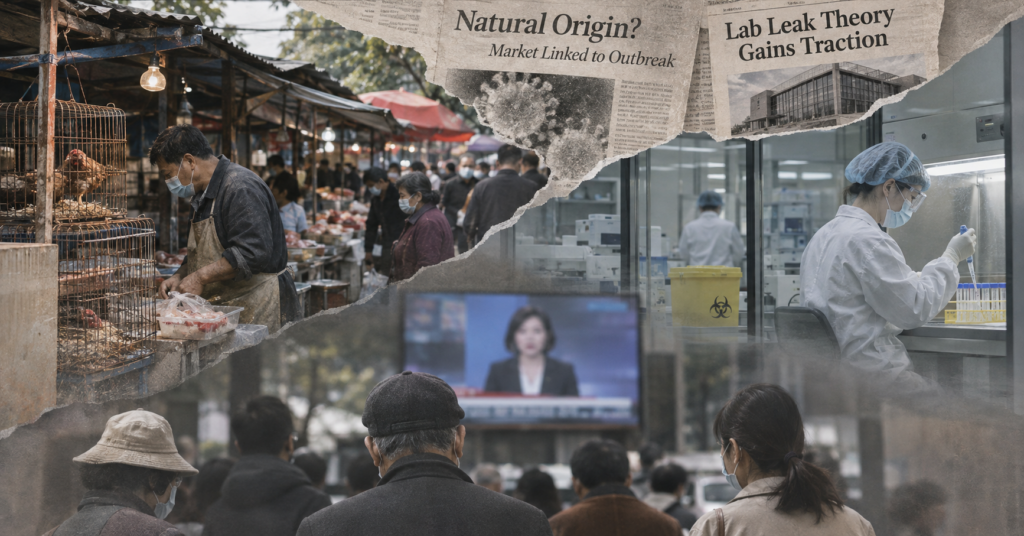
We now inhabit a binary culture, a world divided into oppositional belief sets.
This mainstream belief set discredits all who oppose the defined narrative: that the viral COVID-19 pandemic originated at the Huanan Seafood Market in Wuhan. It is considered by some to be almost immoral to take exception to the “official story,” and those who do so are quickly dismissed as conspiracy theorists.
Wet Market
Zoonotic Spillover
On February 19, 2020, The Lancet, one of the most respected and influential medical journals in the world, published a statement signed by 27 scientists, that expressed “solidarity with all scientists and health professionals in China” and asserted: “We stand together to strongly condemn conspiracy theories suggesting that COVID-19 does not have a natural origin.” It was later revealed that the Lancet statement was not only signed but organized by a zoologist named Peter Daszak, President of EcoHealth Alliance a corporate go-between, reallocating U.S. government grant funding to a lab conducting gain-of-function research (GoFR) in China, chiefly the Wuhan Institute of Virology (WIV). Why?
In a congressional hearing on May 11, 2021 about Anthony Fauci’s role as the Chief Medical Advisor to the United States Office of the President, senator Rand Paul stated that “the U.S. has been collaborating with Shi Zhengli of the Wuhan Virology Institute, sharing discoveries about how to create super viruses. This gain-of-function research has been funded by the NIH.”
Fauci responded “with all due respect, you are entirely and completely incorrect… the NIH has not ever and does not now fund gain-of-function research (conducted at) the Wuhan Institute of Virology.”
Washington Post rated Paul’s accusation against Fauci as having “significant omissions,” while Fauci defenders emphasize narrow GOF definitions exclude the work. Congressional Republicans pressed Fauci on discrepancies with his prior statements, but no formal false testimony finding emerged. The issue remains polarized without legal resolution.
In May 2024 House hearing, NIH Deputy Director Lawrence Tabak testified NIH funded GOF at WIV via EcoHealth under the “generic” definition, contradicting Fauci’s 2021 denial, though he noted unregulated low-risk variants exist widely. Rutgers microbiologist Richard Ebright cited grant documents showing mutant SARS-like viruses with enhanced human cell infectivity and mouse virulence.
Ebright said: “The documents make it clear that assertions by the NIH director, Francis Collins, and the NIAID director, Anthony Fauci, that the NIH did not support gain-of-function research or potential pandemic pathogen enhancement in Wuhan are untruthful.”
Wuhan Lab
Lab Leak
Ample evidence exists to support the possibility that sloppy lab procedures at the Wuhan Institute of Virology (WIV) resulted in a world pandemic. The Decentralized Radical Autonomous Search Team Investigating COVID-19 (DRASTIC) consists of The Seeker, a key member from West Bengal proficient in digging up data as well as exceptional individuals like Gilles Demaneuf, a data scientist from Auckland, and Dr. Monali Rahalkar and Dr. Rahul Bahulikar, scientists in Biology from Pune. On June 2, 2021, Newsweek recognized their success in an “Exclusive: How Amateur Sleuths Broke the Wuhan Lab Story and Embarrassed the Media.”
In November 2020, Jamie Metzl, a former executive vice president of the Asia Society who sits on the World Health Organization’s advisory committee on human genome editing, and served in the Clinton administration as the National Security Council’s director for multilateral and humanitarian affairs wrote to David Quammen, a foremost science journalist and author of the influential book Spillover: Animal Infections and the Next Human Pandemic, sharing a scientific paper Metzl wrote that posited a laboratory origin, based on some of the unusual features of the SARS-CoV-2 sequence.
Quammen wrote back, “I want to understand why, in addition to evidence or the absence of evidence, these theories have such appeal. In connection with that, a question, and I don’t mean it to be coy, merely curious: Do you believe that Lee Harvey Oswald, acting alone, killed JFK? Or not?”
Of course the Chinese government would not like to see the Wuhan Institute of Virology end up as this century’s successor to the grassy knoll, so they remain unwilling to permit further investigation, silent in regard to requests for information like:
- laboratory notebooks from the WIV, which did extensive and risky research into bat coronaviruses;
- medical records of WIV laboratory workers, a number of whom are believed to have been sickened before the official onset of the COVID-19 pandemic;
- the main database of the viral sequences maintained at the WIV’s laboratories, which was taken offline without explanation in the fall of 2019.
The National Institute of Health (NIH) also continues to withhold critical documents that could shed light on the origin of the coronavirus pandemic.
When the Narrative Began to Shift
By 2021, something remarkable was happening. The laboratory-origin hypothesis, widely dismissed as a conspiracy theory just a year earlier, was becoming a legitimate subject of investigation. The science had not suddenly established that the virus came from a laboratory. What changed was the willingness of government officials, scientists, and journalists to consider the possibility. That distinction matters. There is a world of difference between saying a theory is unproven and declaring it debunked. Yet much of the mainstream media had blurred that distinction, relying on statements from established scientific authorities to determine which explanations deserved public consideration.
The Washington Post Rewrites the Narrative
In February 2020, The Washington Post published an article characterizing Senator Tom Cotton’s suggestion of a possible laboratory origin as a debunked conspiracy theory. In June 2021, the newspaper issued a correction, removing those characterizations because the origins of the virus had never been determined. Read the Washington Post article and correction.
Consider the implications. A major American newspaper had dismissed an explanation as discredited, only to acknowledge more than a year later that the question had never been resolved. Correcting the record is responsible journalism. But the correction also exposes the problem with declaring a scientific question settled before the evidence warrants it. How many readers encountered the original accusation but never saw the correction?
Facebook Changes the Rules
On May 26, 2021, Facebook announced that it would no longer remove claims that COVID-19 was human-made or manufactured. The company explained that ongoing investigations and consultations with public-health experts had prompted the policy change. Read Facebook’s original policy update.
The policy concerned claims of human manufacture, which are distinct from the possibility that a naturally occurring virus escaped from a laboratory. Nevertheless, the reversal raised an obvious question about the authority social media platforms had assumed in policing scientific discussion. Who decides what constitutes misinformation when the underlying facts remain uncertain? Facebook’s decision illustrates how easily a provisional scientific judgment can become a platform rule governing public speech.
The FBI, CIA, and a Congress Divided
In February 2023, FBI Director Christopher Wray publicly confirmed that his agency considered a laboratory-associated incident in Wuhan the most likely origin of COVID-19. The FBI expressed moderate confidence in that assessment. The Department of Energy had reached a similar conclusion with low confidence. Not everyone in the intelligence community agreed, but the laboratory hypothesis was no longer confined to independent commentators and political skeptics.
Meanwhile, Congress was preparing to investigate.
On March 8, 2023, the Republican-led House Select Subcommittee on the Coronavirus Pandemic held its first hearing on COVID-19 origins. Former CDC Director Robert Redfield, scientist and policy expert Jamie Metzl, and science writer Nicholas Wade were among those testifying. The investigation continued throughout Joe Biden’s presidency, examining federal funding of coronavirus research, the Wuhan Institute of Virology, and the role of government scientists in shaping public discussion. By June 3, 2024, Anthony Fauci was appearing before the committee in a nationally watched hearing. Republicans, led by Chairman Brad Wenstrup, questioned whether Fauci and other federal officials had helped discredit the laboratory-origin hypothesis while overseeing research funding connected to Wuhan.
Democrats, led by Ranking Member Raul Ruiz, disputed allegations that Fauci had orchestrated a campaign to suppress the theory. Importantly, they did not rule out a laboratory accident. Their position was that the evidence remained inconclusive and that the Republican investigation had failed to substantiate its most serious accusations.
In December 2024, the two sides published competing reports. The Republican majority report concluded that COVID-19 most likely emerged from a laboratory-related incident in Wuhan and alleged that influential scientific statements had helped discredit the hypothesis. The Democratic minority report rejected allegations of a Fauci-directed suppression campaign and argued that the investigation had failed to determine the virus’s origin. Same congressional investigation. Much of the same evidence. Two sharply different interpretations.
Then came another development. On January 25, 2025, the CIA publicly announced that it now favored a research-related origin, although with low confidence. Remarkably, the assessment had been commissioned under the outgoing Biden administration and was released after Donald Trump returned to the White House. Neither the congressional investigation nor the CIA assessment conclusively established where the virus originated. But the controversy demonstrated how thoroughly a scientific question had become entangled with politics. Even as federal investigators reached differing conclusions, congressional leaders debated not only the evidence but also the credibility, conduct, and motivations of those who presented it. The public was left watching competing institutions argue over an unresolved question that, only a few years earlier, some prominent voices had declared effectively settled.
When science becomes a political battleground, the evidence risks becoming secondary to the identity of those presenting it.
The Public Was Already Changing Its Mind
The change was not confined to government agencies or newspaper editorial offices. According to Economist/YouGov polling, 49% of Americans believed in May 2020 that COVID-19 had probably or definitely originated in a Chinese laboratory. By May 2021, that figure had reached 58%. In March 2023, it stood at 66%.
The numbers reveal a growing divide between the early public presentation of scientific consensus and what many Americans had come to believe. Public opinion does not establish scientific truth. But it tells us something about the credibility of the institutions responsible for communicating it. When the official explanation is presented as settled, only to be reopened later, people begin questioning not just the explanation but the institutions that insisted upon it.
But beneath those national averages is a remarkable political divide. In May 2020, 72% of Republicans believed the virus originated in a Chinese laboratory, compared with just 33% of Democrats. By March 2023, those numbers had climbed to 85% of Republicans and 53% of Democrats. Even in May 2025, the divide remained substantial: 81% of Republicans versus 41% of Democrats.
How does a question about the biological origins of a virus become so closely associated with political identity? The evidence had not established a definitive answer, yet Americans increasingly interpreted the competing explanations through partisan lenses. Donald Trump has publicly advocated the laboratory-origin hypothesis, while many of his political opponents remain skeptical. The same scientific uncertainty becomes entangled with political loyalties, institutional trust, and competing media narratives.
Here’s another symptom of our binary culture. Rather than evaluating the evidence independently, Americans risk allowing political affiliation and trusted news sources to influence which scientific explanations they consider credible. The question is no longer simply where the virus originated, but whose version of events people are willing to believe.
The Rise of Independent Journalism
While mainstream news organizations were often looking to government agencies and established scientific authorities for guidance, independent researchers and commentators were following their own leads. Groups such as DRASTIC investigated research records, archived documents, and publicly available scientific material. Their work attracted attention to questions that deserved further investigation. Not every independent investigator was correct, and some commentators promoted claims far beyond the evidence. But independent inquiry provided an alternative to the institutional filtering that had characterized much early reporting.
Meanwhile, the American news audience was changing. Pew Research Center reports that television’s share as Americans’ preferred news platform fell from 35% in 2020 to 28% in 2026. Preference for social media increased from 11% to 19% during the same period. Podcasts, independent newsletters, YouTube channels, and alternative news platforms now compete directly with the networks and newspapers that once dominated public discourse. This migration began well before COVID-19, and it cannot be attributed to the pandemic alone. But the origins controversy provides a revealing example of why some audiences became increasingly skeptical of traditional gatekeepers.
When Journalism Becomes Narrative Management
Journalism is supposed to question authority, not merely transmit its conclusions. Scientific institutions have legitimate expertise. Government investigators have access to evidence unavailable to the public. News organizations must weigh the credibility of their sources. But expertise is not infallibility, and institutional agreement is not a substitute for independent verification.
When journalists adopt official pronouncements as unquestionable facts, they risk turning news coverage into narrative management. When social media companies enforce those judgments by restricting discussion, the consequences extend beyond journalism into the boundaries of public debate. The COVID-19 origins controversy demonstrates the danger of that arrangement.
The scientific question remains unresolved. The questions about journalism, censorship, institutional interests, and public trust are very much alive. Perhaps the most consequential lesson of the pandemic is not where the virus originated, but how quickly uncertainty is transformed into certainty, dissent into disinformation, and legitimate questions into conspiracy theories.
The purpose of journalism is not to protect the prevailing narrative. It is to investigate whether that narrative deserves to prevail.

Stepka Volkov is the skeptical voice behind Dezinformatsiya Journal, where he examines media narratives, political influence, institutional power, and the shifting boundaries of accepted truth. With a contrarian eye and a healthy distrust of conventional wisdom, he questions authority, challenges prevailing assumptions, and explores the uneasy territory between fact, opinion, and disinformation. His guiding philosophy: Question everything, especially those who insist the debate is over.